


 Contact Us: (65) 6419 2850


Selective vs Drive-In Pallet Racking: Which System Fits Your Warehouse?
Selective and drive-in pallet racking solve different warehouse storage requirements. Selective racking prioritises direct access to individual pallets, while drive-in racking prioritises storage density by arranging pallets in deeper lanes with fewer aisles.
For businesses evaluating a pallet racking system in Singapore that can be efficiently used for warehouses, the choice should therefore be based on inventory behaviour rather than storage capacity alone. SKU quantities, pallet turnover, stock rotation, forklift movement and required accessibility all influence which configuration is more appropriate.
A warehouse containing many different products that need frequent retrieval may benefit from direct-access storage. A facility holding larger quantities of similar palletised goods may be able to use deeper storage lanes more effectively.
This comparison focuses specifically on those operational differences. Rather than covering every aspect of pallet racking, it explains when selective or drive-in storage is better aligned with a particular inventory profile.
What Is Selective Pallet Racking?
Selective pallet racking is a storage configuration in which individual pallet positions are generally accessible directly from an aisle. Upright frames and horizontal beams create multiple storage levels, while aisles provide forklifts with access to the rack faces.
Its defining characteristic is selectivity.
A forklift can retrieve a required pallet without first removing several pallets positioned in front of it. This makes selective racking useful for warehouses carrying multiple SKUs or inventory that needs frequent individual access.
The trade-off is aisle space. Because rack faces need to remain accessible, a greater proportion of the warehouse floor can be allocated to forklift travel compared with some high-density systems.
Selective racking is therefore primarily an accessibility-focused configuration rather than a maximum-density solution.
What Is Drive-In Racking?
Drive-in racking is a high-density pallet storage configuration that places pallets in deep lanes rather than providing an aisle along every rack face. Forklifts enter these storage lanes to place or retrieve pallets.
This layout can reduce the number of aisles required within the storage area.
The reduction in aisle space allows a larger proportion of the warehouse footprint to be used for pallet positions. However, pallets within a lane are not all equally accessible.
A Drive-in Racking system in Singapore for warehouse operators should therefore be assessed according to inventory quantities and rotation requirements.
The configuration is generally more compatible with larger quantities of similar goods than with inventory requiring frequent access to many individual SKUs.
Selective vs Drive-In Racking at a Glance
The main difference between the systems is the balance between pallet accessibility and storage density.
| Consideration | Selective Pallet Racking | Drive-In Racking |
|---|---|---|
| Individual Pallet Access | High | Lower within storage lanes |
| Storage Density | Moderate | High |
| Aisle Requirement | More aisles | Fewer aisles |
| SKU Selectivity | High | Better suited to grouped inventory |
| Forklift Movement | Primarily along rack aisles | Forklift enters storage lanes |
| Inventory Rotation | Flexible | Depends strongly on lane arrangement |
| Typical Use | Multiple SKUs requiring frequent access | Larger quantities of similar palletised stock |
Neither system is universally more efficient. Their suitability depends on what the warehouse stores and how those goods move.
Storage Density Differences
Storage density measures how much inventory can be accommodated within a defined warehouse area. Drive-in racking generally provides greater density because it reduces the floor area dedicated to access aisles.
Selective racking positions rows of racks alongside forklift aisles. Those aisles consume space but provide direct access to individual pallet locations.
Drive-in racks arrange pallets at greater depth. Several positions can occupy the same storage lane, allowing the layout to concentrate inventory into a smaller floor area.
However, theoretical density and practical utilisation are not always identical.
A drive-in lane assigned to one SKU may remain partly empty if there are not enough pallets of that product to fill the available positions. A warehouse with highly fragmented inventory may therefore achieve less practical benefit from deep lanes than capacity calculations initially suggest.
Density should be evaluated together with SKU quantities.
Pallet Accessibility
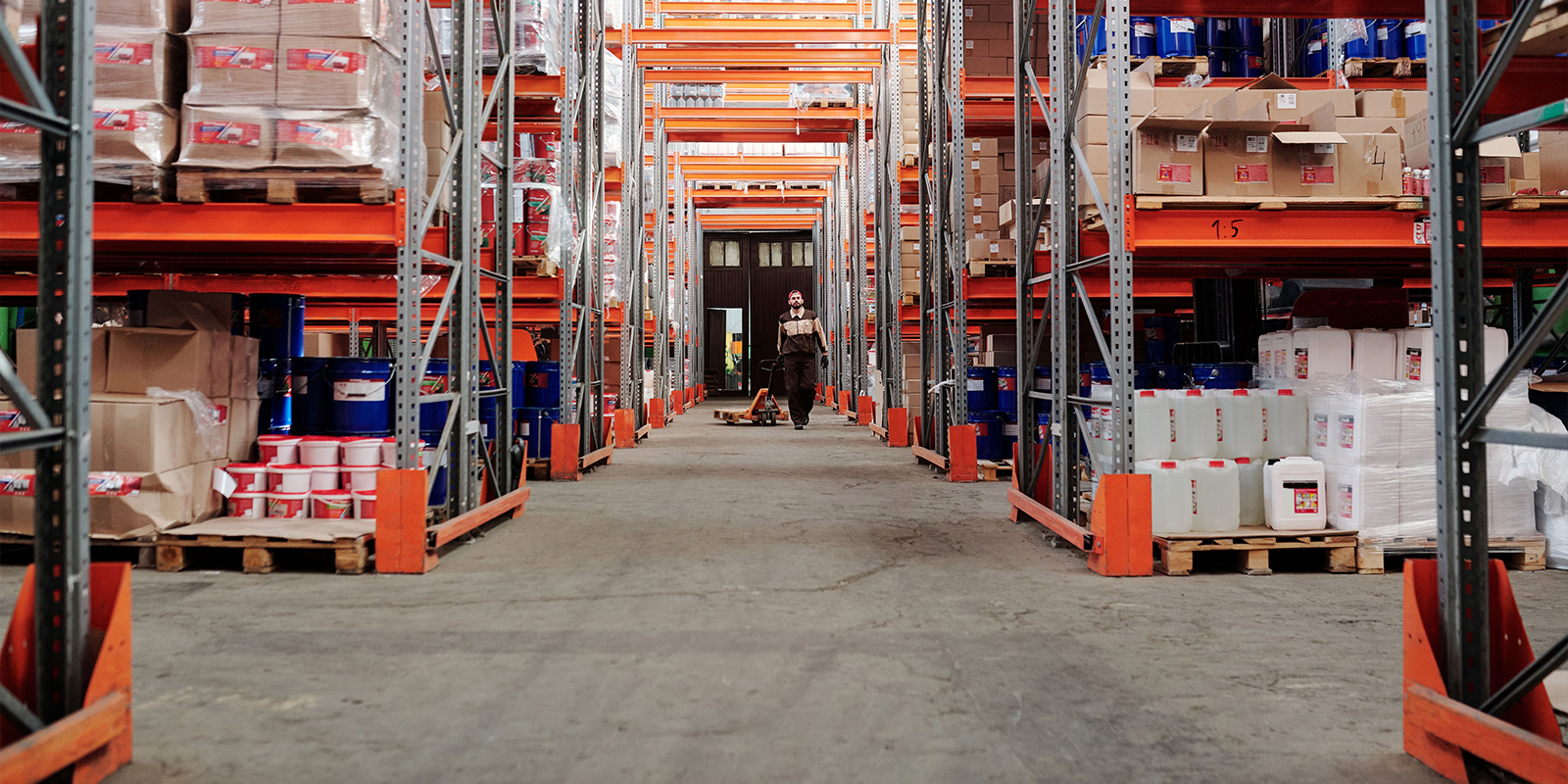
Pallet accessibility refers to how easily a particular pallet can be reached without moving other inventory first. This is one of the clearest differences between selective and drive-in systems.
Selective racking provides a high level of direct accessibility because each pallet position faces an aisle.
This is useful when warehouse staff need to retrieve specific pallets frequently or when stock consists of many individual product lines.
Drive-in racking works differently. Pallets are stored sequentially within lanes, so pallets positioned deeper in the system cannot necessarily be accessed independently.
This reduced selectivity is not inherently a disadvantage. It becomes a problem only when the inventory requires a level of access that the lane configuration cannot provide efficiently.
The appropriate system therefore depends on whether direct pallet access or compact storage has greater operational value.
Inventory and SKU Requirements
SKU structure is one of the most important factors when comparing selective and drive-in racking. A SKU identifies a distinct inventory item, and warehouses can differ greatly in how many pallets they hold for each SKU.
Selective pallet racking can accommodate a broad SKU mix because individual pallet positions remain accessible.
A warehouse might hold only one or two pallets of some products and larger quantities of others without requiring every SKU to fill a dedicated deep-storage lane.
Drive-in racking becomes more practical when multiple pallets of the same or compatible inventory can be grouped together.
If every lane contains only a small quantity of stock, much of the potential density can be lost.
Before choosing between the systems, warehouse operators should examine the number of pallets normally held per SKU rather than considering only the total pallet count.
Inventory Rotation Considerations
Inventory rotation determines the sequence in which stored goods need to be retrieved. The racking configuration should support that sequence without creating unnecessary pallet movements.
Selective racking offers substantial flexibility because individual pallet positions can be reached directly.
This makes it easier to manage inventory where specific pallets need to be selected independently.
Drive-in racking introduces a lane-based retrieval sequence. Pallets positioned near the access point may need to be removed before pallets stored deeper within the lane can be reached.
This characteristic needs to correspond with the stock-management method.
Products with relatively simple rotation requirements and sufficient pallet quantities may work effectively within deep lanes. Inventory requiring precise individual pallet selection may be better suited to direct-access storage.
Rotation should therefore be assessed before density, not after the rack has already been selected.
Forklift Access Requirements
Both selective and drive-in racking depend on appropriate material-handling equipment, but forklift movement differs substantially between the configurations.
With selective racking, the forklift generally travels along an aisle and approaches the rack face to place or retrieve a pallet.
The aisle therefore needs to correspond with the manoeuvring characteristics of the equipment.
In drive-in racking, the forklift enters the rack structure's storage lane. This creates a different operating environment because the equipment moves within a defined space between rack components.
Forklift dimensions and manoeuvrability become particularly important.
Operators also need to position pallets correctly within the lane while avoiding unnecessary contact with the racking structure.
A proposed high-density layout should therefore be checked against the actual forklifts that will service it rather than assuming existing equipment is automatically suitable.
Warehouse Space Considerations
Warehouse dimensions can influence which configuration provides practical value. Floor area, building shape and available height should be considered together.
Drive-in racking can be attractive where reducing aisle requirements creates meaningful additional pallet capacity.
However, the warehouse still requires sufficient circulation routes outside the storage lanes. Receiving, staging, replenishment and dispatch areas should not be compromised simply to maximise the number of rack positions.
Selective racking uses more aisle space but can create a straightforward storage layout where products are distributed across many accessible locations.
Irregular building geometry can also affect configuration efficiency.
Columns, walls, doors and other physical constraints may make some areas more suitable for one layout than another.
The best configuration is therefore determined by usable warehouse space, not simply total floor area.
When Selective Pallet Racking May Be Suitable
Selective pallet racking may be suitable when warehouse operations place a high value on accessibility and SKU flexibility.
Typical conditions include warehouses that:
- Carry many different SKUs
- Store relatively small pallet quantities per SKU
- Require frequent retrieval of individual pallets
- Experience regular changes in inventory mix
- Need straightforward access for replenishment and picking
The system can also be useful where warehouse managers want flexibility in assigning pallet positions to different products.
Its lower density compared with deep-storage configurations should be evaluated against the operational benefit of direct access.
For some warehouses, reducing retrieval complexity can be more valuable than maximising the number of pallet positions.
When Drive-In Racking May Be Suitable
Drive-in racking may be suitable when the inventory profile allows multiple pallet positions to be grouped within deep storage lanes.
Typical conditions include facilities holding substantial quantities of the same or compatible products and where immediate access to every individual pallet is not required.
The configuration can also be relevant where warehouse space is limited and increasing storage density is an important objective.
However, the decision should be supported by actual inventory data.
A warehouse should determine whether it consistently holds enough pallets per SKU to make effective use of the lanes.
Forklift compatibility and inventory rotation should also be confirmed.
High-density storage provides the greatest value when the inventory naturally fits the configuration rather than when operational processes need to be forced around it.
Can a Warehouse Use Both Systems?
A warehouse can use selective and drive-in racking in different zones when its inventory contains products with different storage requirements.
This can be more practical than forcing the entire facility into one configuration.
For example, fast-moving products with many SKUs can occupy selective pallet racks, while larger quantities of suitable reserve stock can use drive-in storage.
The key is to define each storage zone according to inventory behaviour.
A mixed configuration also needs a coordinated warehouse layout. Forklift routes, replenishment activity and movement between storage areas should remain practical.
Using multiple rack types should therefore reflect a deliberate storage strategy rather than simply filling available spaces with different systems.
How to Compare the Two Systems for Your Warehouse
A useful comparison starts with inventory data rather than rack dimensions. Warehouse operators can evaluate five questions.
1. How Many Pallets Are Held Per SKU?
Small quantities across many SKUs generally favour greater selectivity. Larger quantities of similar inventory can make deeper storage more practical.
2. How Often Are Individual Pallets Retrieved?
Frequent individual retrieval increases the value of direct access.
3. What Rotation Method Does the Inventory Require?
The rack configuration should support the sequence in which goods need to enter and leave storage.
4. How Important Is Maximum Storage Density?
Where floor space is particularly constrained, reducing aisle requirements may create useful capacity if the inventory can support deep-lane storage.
5. Can the Forklift Equipment Operate Effectively?
The proposed layout needs to correspond with forklift dimensions, reach and manoeuvring requirements.
Answering these questions helps distinguish between physical storage capacity and operationally useful capacity.
Frequently Asked Questions (FAQs)
Is drive-in racking better than selective pallet racking?
Neither system is inherently better. Selective racking prioritises direct pallet access, while drive-in racking prioritises storage density. The appropriate system depends on SKU quantities, inventory rotation and warehouse operations.
Which racking system stores more pallets?
Drive-in racking can generally achieve higher storage density because fewer aisles are required. Actual usable capacity depends on whether inventory quantities can effectively fill the storage lanes.
Which system is better for many SKUs?
Selective pallet racking is generally more compatible with a large number of SKUs because individual pallet positions can be accessed directly.
Does drive-in racking require special forklift considerations?
Yes. Forklifts enter the storage lanes, so equipment dimensions, manoeuvrability and operating requirements should be considered during system planning.
Can selective and drive-in racking be installed in the same warehouse?
Yes. Different warehouse zones can use different configurations when inventory characteristics justify them. The overall layout should still support efficient material movement.
What should be checked before choosing a racking configuration?
Important factors include pallets per SKU, load characteristics, inventory turnover, rotation requirements, forklift capabilities, available warehouse space and the level of pallet accessibility required.
Matching Storage Configuration to Inventory Behaviour
The practical difference between selective and drive-in pallet racking is not simply the number of pallets each system can hold. It is how those pallets can be organised and accessed during normal warehouse operations.
Selective racking supports high SKU selectivity and direct pallet access. Drive-in racking uses deeper storage lanes to increase density where inventory quantities and rotation requirements allow it.
For businesses evaluating a pallet racking system in Singapore that can be effectively used for warehouse operations, the strongest configuration is the one that reflects actual inventory behaviour. Understanding pallet quantities, retrieval frequency and forklift movement before selecting the rack helps ensure that storage capacity remains usable in day-to-day operations.
Determine Which Racking Configuration Fits Your Inventory
The appropriate configuration depends on whether the warehouse requires greater pallet accessibility, higher storage density or a combination of storage zones. Eastern Win Enterprises provides heavy-duty racking solutions for different warehouse and industrial storage requirements in Singapore. Businesses comparing selective pallet storage with configurations for a Drive-In Racking system in Singapore can contact Eastern Win Enterprises to review their warehouse storage requirements.