


 Contact Us: (65) 6419 2850


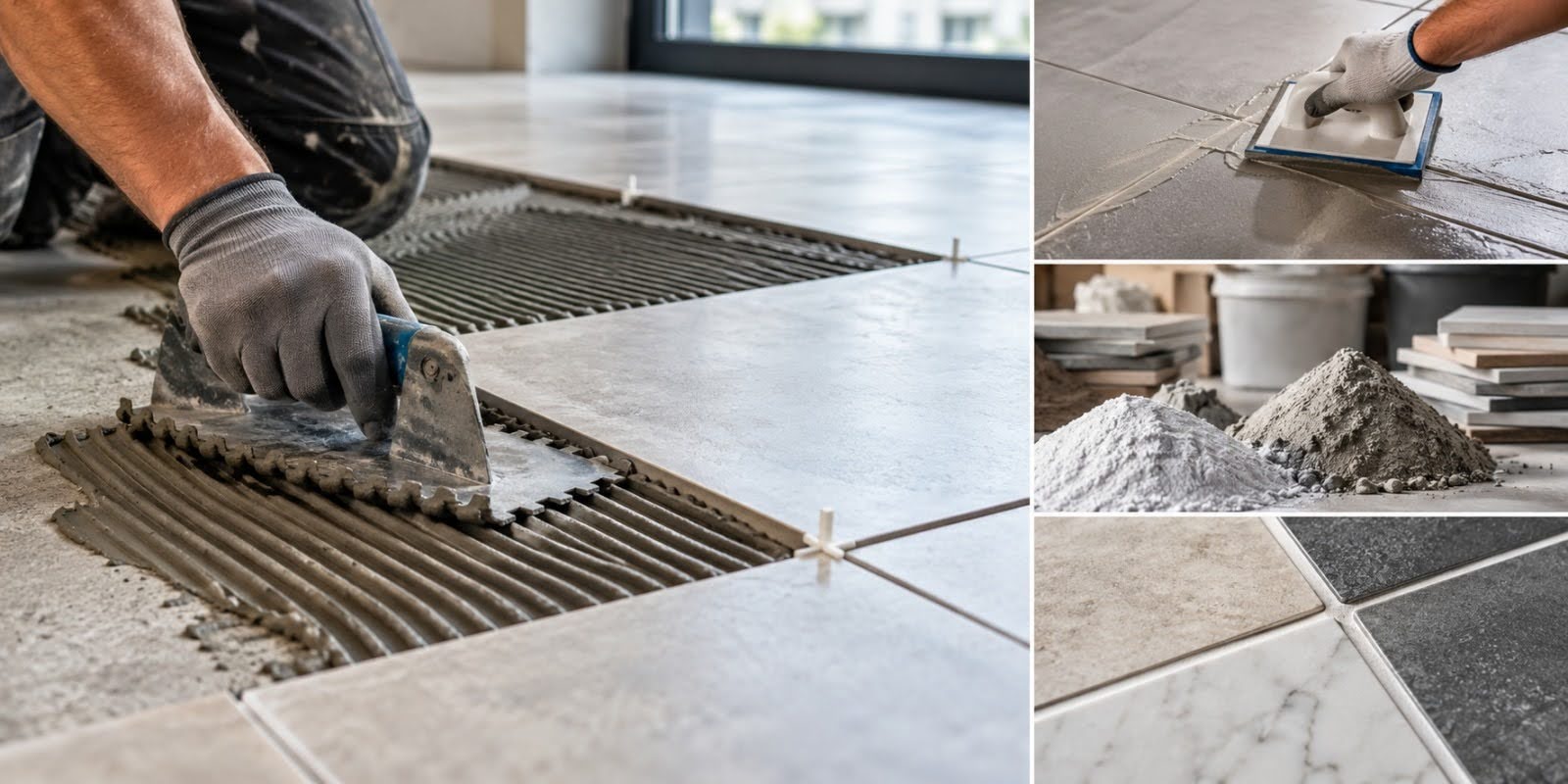
Tile adhesives, mortars and grouts are construction materials used for different stages of installation, bonding and structural support. Although these products are often grouped together, each performs a different function and should be selected according to the substrate, tile type, application environment and performance required.
Tile adhesive is specifically formulated to bond tiles to suitable substrates. Mortar is a broader cement-based material used in masonry, rendering, bedding and selected tile applications, while grout is generally used to fill joints, voids or structural spaces depending on the product type.
Non-shrink grout is different from conventional tile grout. It is a specialised cementitious material commonly used for structural grouting, equipment bases, void filling and other applications where dimensional stability and load transfer are important.
For construction projects in Singapore, correct material selection depends on understanding how these products differ and where each one should be used. This guide explains tile adhesives, mortars and grouts, including substrate preparation, installation requirements, product selection and application considerations.
What Is Tile Adhesive?
Tile adhesive is a bonding material formulated to secure tiles to prepared substrates such as concrete, cement screed, plaster or other suitable surfaces. It is commonly supplied as a cementitious powder or ready-mixed product depending on the formulation.
The adhesive creates a bond between the back of the tile and the substrate. Its performance depends on several factors, including tile type, surface preparation, adhesive thickness, environmental conditions and installation method.
Different tile adhesive products are designed for different applications. Some are suitable for ceramic tiles, while others may be formulated for porcelain, natural stone or larger-format tiles.
The correct adhesive should therefore be selected according to the specific tile and substrate rather than using one product for every installation.
How Tile Adhesive Works
Tile adhesive works by creating mechanical and chemical adhesion between the tile and the prepared substrate. Once applied, the adhesive cures and develops sufficient strength to hold the tile in place.
Cementitious adhesives generally cure through hydration, where water reacts with cement-based components in the product.
The bond depends on proper contact between the adhesive, tile and substrate. If the surface is dusty, weak or contaminated, the adhesive may bond to the contamination rather than to the structural surface.
Application thickness also matters. Using an adhesive outside its recommended thickness can affect curing and performance.
Correct mixing, application and curing are therefore essential parts of the installation process.
What Is Mortar?
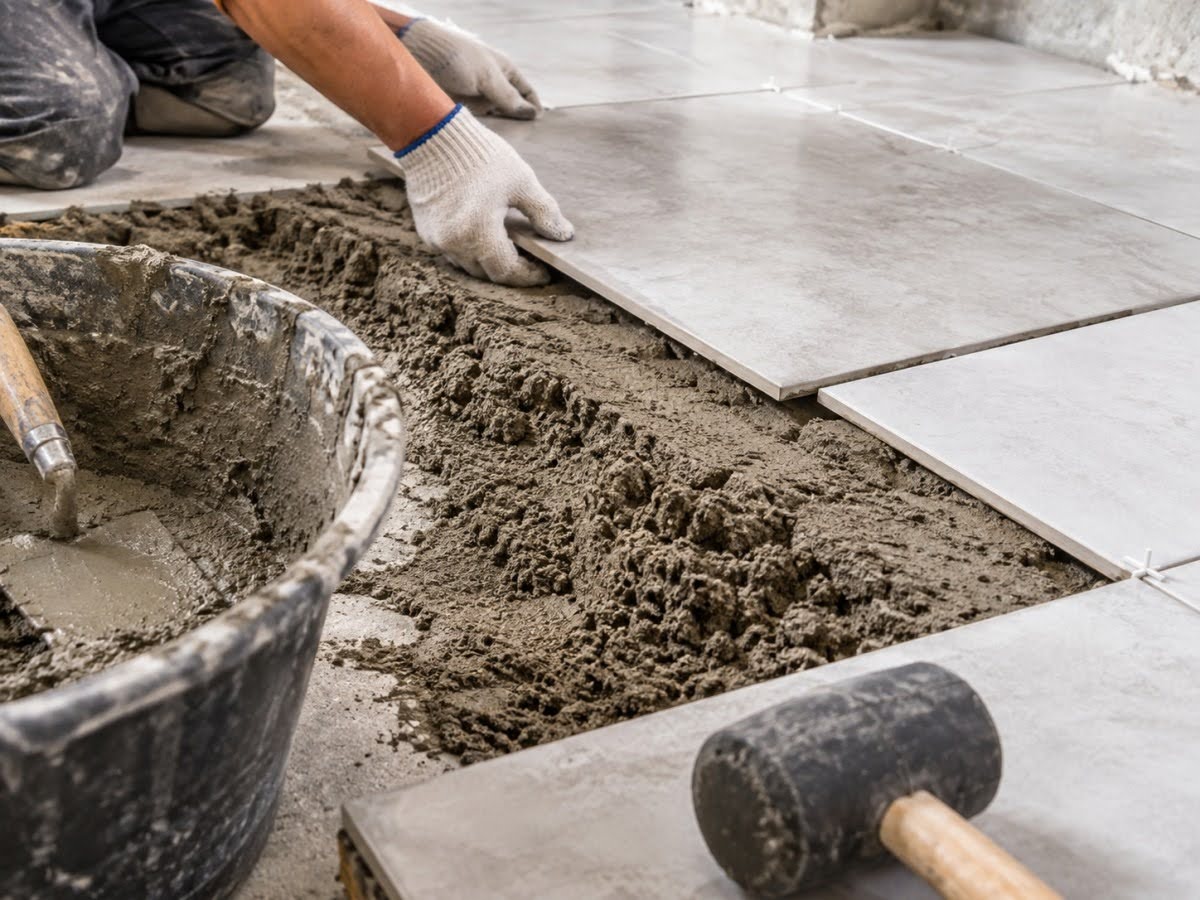
Mortar is a cement-based construction material commonly made from cement, sand and other additives. It is used for masonry, rendering, bedding and a variety of general construction applications.
Mortar can also be used in some traditional tile installations, particularly where tiles are bedded into a relatively thick cement-sand layer.
However, conventional mortar and modern tile adhesive are not interchangeable in every application.
Tile adhesives are specifically formulated to improve bonding, workability and performance across selected tile and substrate combinations.
Mortar remains useful where thicker bedding layers, masonry work or other construction functions are required.
Tile Adhesive vs Traditional Mortar
Tile adhesive and traditional mortar differ mainly in formulation, thickness, bonding performance and installation method. Tile adhesive is engineered specifically for tile bonding, while traditional mortar performs a broader construction function.
The main differences can be summarised as follows:
| Consideration | Tile Adhesive | Traditional Mortar |
|---|---|---|
| Primary purpose | Bonding tiles | Bedding, masonry and general construction |
| Typical application thickness | Relatively thin | Generally thicker |
| Formulation | Modified for adhesion and workability | Cement and sand-based |
| Tile compatibility | Product-specific | More limited depending on method |
| Installation control | More consistent when mixed correctly | More dependent on site preparation |
| Typical use | Modern tile installation | Traditional bedding and construction work |
The appropriate material depends on the installation system and substrate conditions.
Different Types of Tile Adhesive
Tile adhesives are available in different formulations because tile installations vary in size, material, location and exposure conditions. The appropriate product should be selected according to the project requirements.
Common categories can include:
- Cementitious tile adhesives;
- Polymer-modified adhesives;
- Ready-mixed adhesives;
- Adhesives for large-format tiles; and
- Specialised adhesives for selected substrates or environments.
The classification alone does not determine suitability. Individual products can differ significantly in bond strength, flexibility, open time and recommended tile types.
Technical data should therefore be reviewed before product selection.
Cementitious Tile Adhesive
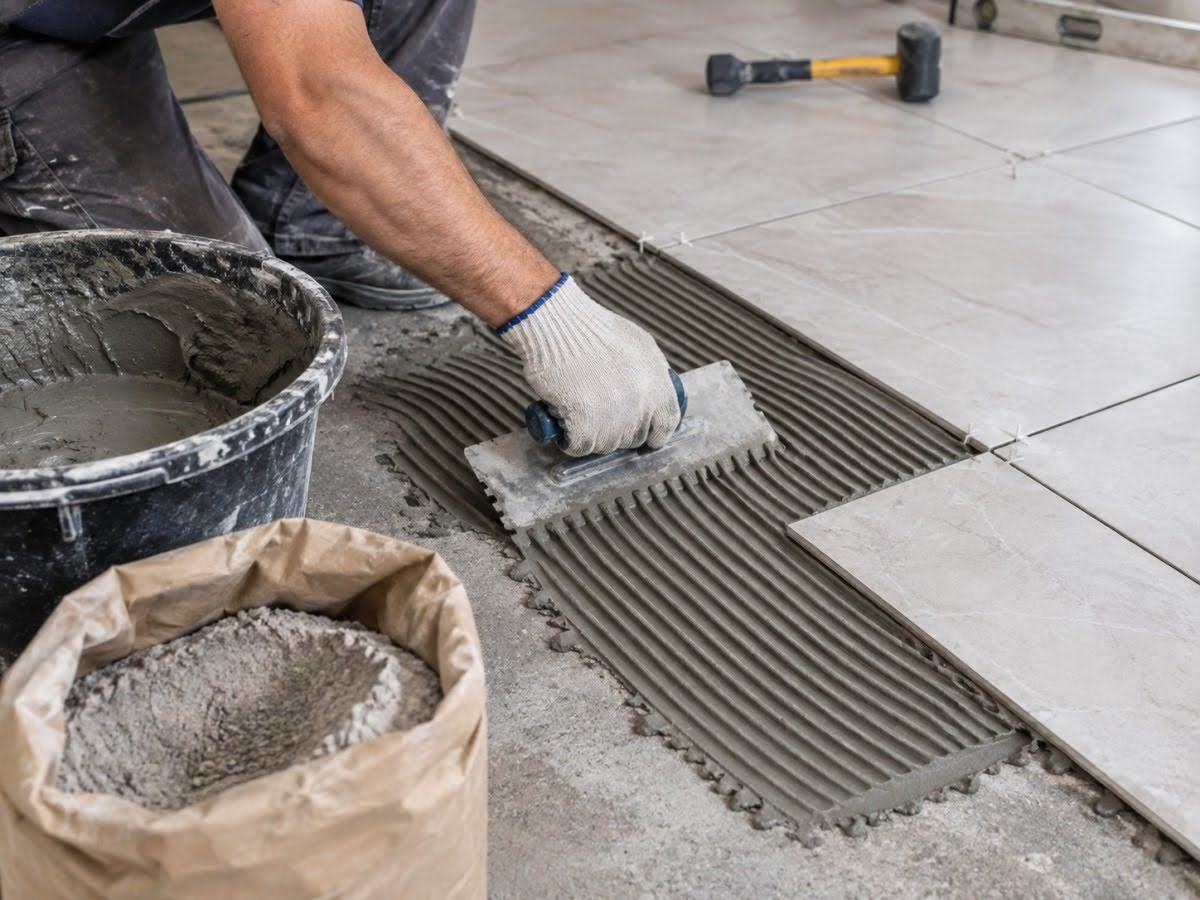
Cementitious tile adhesive is a dry powder product typically mixed with water before use. It is one of the most common types used for wall and floor tile installation.
The product usually contains cement, graded fillers and performance-enhancing additives.
Once mixed, it is applied using a notched trowel to create a controlled adhesive layer.
Cementitious adhesives can be formulated for different tiles and installation conditions.
Some products are designed for normal ceramic tiles, while others provide enhanced adhesion or flexibility for more demanding applications.
The manufacturer’s instructions should be followed for water ratio, mixing time and application thickness.
Polymer-Modified Tile Adhesive
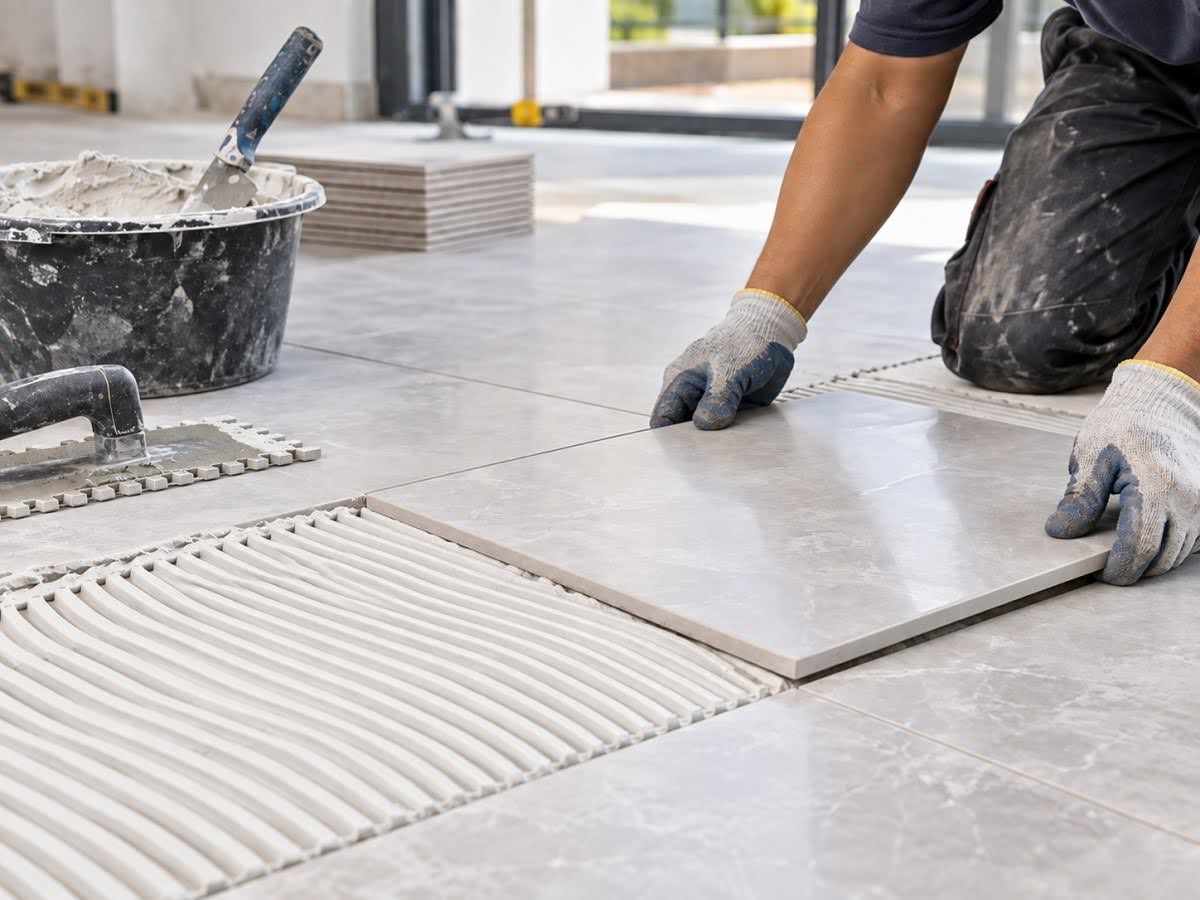
Polymer-modified tile adhesive contains additives intended to improve characteristics such as adhesion, flexibility and water retention. These properties can help the adhesive perform under more demanding installation conditions.
Modified adhesives may be suitable for dense tiles such as porcelain or for applications where additional movement accommodation is required.
They may also offer improved bonding to selected substrates.
However, polymer modification does not mean the adhesive is suitable for every surface or environment.
The specific product requirements should still be reviewed before installation.
Choosing Tile Adhesive by Tile Type
Tile type affects adhesive selection because different tiles have different absorption, weight and surface characteristics.
Ceramic tiles are generally more porous than porcelain tiles. Porcelain has lower water absorption, which can make bonding more demanding.
Natural stone may introduce additional considerations such as moisture sensitivity or staining.
Large-format tiles can place greater demands on adhesive coverage and flatness.
The selection process should therefore consider the actual tile material, dimensions and installation position.
Using a product simply because it is labelled as “tile adhesive” may not be sufficient.
Ceramic Tile Applications
Ceramic tiles are commonly installed using cementitious tile adhesives formulated for normal wall and floor applications. Their relatively porous body can provide suitable bonding characteristics when paired with an appropriate adhesive.
The substrate should still be properly prepared.
Surface flatness, cleanliness and strength influence the performance of the installation.
The adhesive should be mixed and applied according to manufacturer guidance.
Where ceramic tiles are installed in wet or exterior environments, additional requirements may apply.
Porcelain Tile Applications
Porcelain tiles generally have lower water absorption than conventional ceramic tiles. This can make adhesion more demanding because the adhesive has less opportunity to mechanically key into the tile body.
A suitable adhesive should therefore be selected specifically for porcelain or other dense tiles.
Proper coverage is also important.
Large or heavy porcelain tiles may require additional installation measures such as back-buttering depending on the product and tile dimensions.
The complete installation system should be reviewed rather than considering the adhesive in isolation.
Large-Format Tile Installation
Large-format tiles require careful substrate preparation because small surface irregularities can create significant alignment and coverage problems across a larger tile area.
The substrate should be flat and stable before installation.
Adhesive coverage is also important because voids behind large tiles can reduce support and increase the risk of localised stress.
A suitable tile adhesive should be selected for the tile size and application.
Trowel size, adhesive consistency and installation technique should support adequate contact between the tile and substrate.
Natural Stone Considerations
Natural stone requires careful adhesive selection because some stone materials can be sensitive to moisture, staining or dimensional movement.
Light-coloured stone can sometimes require a white or specially formulated adhesive to reduce the risk of visible discolouration.
Porosity varies widely between stone types.
The installation method should therefore be based on the specific material rather than treating all natural stone as identical.
Where product compatibility is uncertain, technical guidance should be reviewed before installation.
Understanding Substrates
A substrate is the surface onto which tiles, mortars or grouts are applied. Substrate condition is one of the most important factors affecting tile installation performance.
Common substrates include concrete, cement screed, plaster, masonry and other suitable construction surfaces.
The substrate should generally be stable, clean and capable of supporting the finished installation.
Weak, dusty or contaminated surfaces can compromise adhesion even when the correct product is used.
Substrate movement should also be considered, particularly where different materials meet.
Why Substrate Preparation Matters
Substrate preparation matters because the adhesive bond can only be as reliable as the surface beneath it. Dust, laitance, grease, loose material and weak coatings can reduce adhesion.
The substrate should therefore be assessed before adhesive application.
Preparation can include:
- Removing dust and debris;
- Repairing damaged areas;
- Removing loose coatings;
- Checking moisture conditions; and
- Confirming adequate flatness.
The required preparation method depends on the substrate and adhesive product.
Installation should not begin until the surface is suitable for bonding.
Surface Flatness and Tile Installation
Surface flatness affects tile alignment, adhesive thickness and coverage. Uneven substrates can make it difficult to achieve consistent support beneath the tile.
Large-format tiles are particularly sensitive to surface irregularities.
Using excessive adhesive to compensate for major unevenness may exceed the product’s intended application thickness.
Where necessary, the substrate should be levelled or repaired before tiling.
This allows the tile adhesive to function primarily as a bonding layer rather than as a general levelling material.
Moisture in Tile Installation
Moisture can affect both the substrate and the performance of tile installation materials. Concrete and screeds can retain moisture after construction, while wet areas can be exposed to ongoing water.
The acceptable moisture condition depends on the adhesive and tile system.
Certain products may tolerate damp surfaces, while others require controlled dryness.
Waterproofing should also be treated separately from tile adhesive.
Tile adhesive bonds the tile, while a waterproofing system provides the underlying water barrier where required.
Wet Area Tile Installation
Wet areas require tile adhesives and installation systems suitable for repeated moisture exposure. Bathrooms, toilets, showers and similar spaces typically involve both waterproofing and tile installation requirements.
The waterproofing layer should be completed according to the specified system before tiling.
The tile adhesive must then be compatible with the waterproofed substrate.
Joints, corners and penetrations may require additional detailing.
Tile adhesive should not be relied upon as the primary waterproofing material unless the product is specifically designed and specified for that purpose.
Exterior Tile Applications
Exterior tile installations are exposed to rain, temperature changes and environmental movement. These conditions can place greater demands on the adhesive system than typical interior applications.
The substrate should be stable and properly prepared.
The selected adhesive should be rated for exterior conditions where applicable.
Movement joints and drainage considerations may also be relevant.
Exterior tile systems should therefore be evaluated as complete assemblies rather than focusing only on adhesive strength.
Understanding Mortar Applications
Mortar is used for a wider range of construction activities than tile adhesive. It can be used for blockwork, brickwork, plastering, rendering, bedding and other cement-based applications.
Mortar formulations vary according to the required function.
A masonry mortar has different performance requirements from a tile bedding mortar.
Pre-packed mortar products can provide more controlled composition compared with site-batched mixtures.
The selection should be based on the intended application and required properties.
Pre-Packed Mortar
Pre-packed mortar is manufactured with predetermined proportions of cement, aggregates and additives. It is supplied ready for mixing with the required amount of water.
The controlled formulation can help improve consistency between batches.
Pre-packed products can also simplify site preparation by reducing the need to measure multiple raw materials.
Different products are formulated for different applications.
Tile adhesives, repair mortars, grouts and other materials may all fall within broader pre-packed mortar product categories.
What Is Grout?
Grout is a fluid or semi-fluid material used to fill joints, gaps and voids. Different grout types perform very different functions.
Tile grout is commonly used to fill joints between installed tiles.
Structural grout is used for applications such as equipment bases, bearing plates, structural voids and load transfer.
These products should not be confused simply because both are called grout.
The required performance determines the correct material.
Tile Grout vs Structural Grout
Tile grout and structural grout differ significantly in purpose and performance. Tile grout mainly fills joints between tiles, while structural grout is intended to fill load-bearing or technical voids.
The distinction can be summarised as follows:
| Consideration | Tile Grout | Structural Grout |
|---|---|---|
| Main function | Fill tile joints | Fill structural gaps or voids |
| Typical location | Between tiles | Equipment bases, plates, structural elements |
| Load transfer | Limited | Often important |
| Flow characteristics | Joint filling | Can be highly flowable |
| Dimensional stability | Important for finish | Critical for structural applications |
Product selection should therefore begin with the intended function.
What Is Non-Shrink Grout?
Non-shrink grout is a specialised cementitious grout formulated to minimise dimensional shrinkage during curing and service. It is commonly used where full contact and reliable load transfer are required.
Applications can include machinery bases, baseplates, precast elements, columns, anchor areas and structural voids.
The purpose of non-shrink performance is to reduce the formation of gaps that could occur if conventional cementitious material contracts during curing.
Non-shrink grout should still be installed according to manufacturer requirements.
Water ratio, mixing, placement and curing all affect performance.
How Non-Shrink Grout Works
Non-shrink grout works by using a controlled cementitious formulation designed to compensate for or minimise normal shrinkage during curing.
This helps maintain contact between the grout and surrounding surfaces.
In structural applications, consistent contact is important because loads may need to be transferred through the grouted area.
The material is typically mixed to a defined consistency according to the required application.
Some applications may require flowable grout, while others may use a stiffer consistency.
The product technical data should define the acceptable range.
Common Applications of Non-Shrink Grout
Non-shrink grout is commonly used where void filling, dimensional stability and load transfer are required. It is not primarily a decorative or finishing grout.
Typical applications can include:
- Machine bases;
- Bearing plates;
- Column bases;
- Precast structural elements;
- Anchor pockets; and
- Construction voids.
The actual application should be matched to the product’s specified performance.
Large or unusual grouting conditions may require additional technical assessment.
Equipment Base Grouting
Equipment base grouting fills the space between machinery baseplates and supporting concrete. The grout provides continuous contact and helps transfer loads into the foundation.
The area should be prepared carefully before grout placement.
Loose material, contaminants and weak surfaces can affect bonding.
Formwork may also be required to contain flowable grout during placement.
The grout should be mixed and poured according to the specified water ratio and working time.
Structural Grouting
Structural grouting is used to fill load-bearing spaces in construction assemblies. Applications can include column bases, precast connections and structural bearing areas.
The grout must provide suitable compressive performance and dimensional stability.
Proper placement is important because trapped air or incomplete filling can create voids.
The consistency should be appropriate for the geometry of the space.
Where grout needs to flow into confined areas, a suitably flowable formulation may be required.
Void Filling Applications
Void filling involves placing grout into gaps that need to be filled continuously. The purpose can range from structural support to stabilisation.
The grout should be capable of reaching the full extent of the void.
Flow characteristics become particularly important in narrow or inaccessible spaces.
Large voids may require products designed specifically for thicker placements.
The installation method should prevent segregation and excessive air entrapment.
Choosing Between Tile Adhesive, Mortar and Grout
Tile adhesive, mortar and grout should be selected according to function rather than appearance or general cementitious composition.
Tile adhesive bonds tiles to substrates.
Mortar performs broader bedding, masonry and construction functions.
Grout fills joints or voids, with different formulations available for tile and structural applications.
A simple selection guide is therefore:
- Use tile adhesive when the primary requirement is bonding tiles.
- Use mortar when bedding, masonry or general cementitious construction work is required.
- Use tile grout when filling joints between tiles.
- Use non-shrink grout where structural void filling or load transfer is required.
Final selection should always be checked against the product specification.
Product Selection for Tile Adhesive
Tile adhesive should be selected according to tile type, substrate, location and installation conditions.
The key questions include whether the tile is ceramic, porcelain or stone, whether the application is wall or floor, and whether the installation is internal or external.
Tile dimensions also influence selection.
Large-format tiles may require products designed for improved coverage and performance.
The adhesive should also be compatible with waterproofing or other underlying systems where applicable.
Product Selection for Mortar
Mortar selection should be based on the construction task.
Masonry mortar, plastering mortar, repair mortar and bedding mortar each perform different functions.
Pre-packed products can simplify selection by providing application-specific formulations.
However, the stated use should still be confirmed.
A product intended for tile bonding should not automatically be used for structural repair or vice versa.
Product Selection for Non-Shrink Grout
Non-shrink grout selection depends on the dimensions of the void, required consistency, compressive strength and application conditions.
The required flow characteristics should be considered.
A narrow baseplate gap may require high flow, while another application may require a different consistency.
Placement depth can also influence product suitability.
The manufacturer’s technical data should therefore be reviewed before selecting grout for structural work.
Mixing Tile Adhesive Correctly
Tile adhesive should be mixed according to the manufacturer’s recommended water ratio. Adding excessive water can alter consistency, curing and bonding performance.
The powder should typically be added to measured clean water and mixed until a uniform consistency is achieved.
Some products require a short resting or maturation period before remixing.
Once mixed, the adhesive has a limited working life.
Material that has begun to set should not be retempered with additional water unless specifically permitted by the manufacturer.
Applying Tile Adhesive
Tile adhesive is generally applied using a notched trowel to create controlled ridges and a consistent layer.
The trowel size should suit the tile dimensions and installation requirements.
The tile should be placed while the adhesive remains within its open time.
For larger tiles, back-buttering may be used where recommended to improve coverage.
The objective is to achieve sufficient contact between tile and substrate without excessive voiding.
Adhesive Coverage
Adhesive coverage refers to the proportion of the tile back that is in contact with the adhesive.
Adequate coverage is important because unsupported areas can create weak points.
Coverage requirements can differ between interior, exterior and wet-area applications.
Large-format tiles often require particularly careful installation.
Tiles can be lifted periodically during installation to verify that the adhesive is transferring appropriately.
Mixing Non-Shrink Grout
Non-shrink grout should be mixed using the water ratio and procedure specified by the manufacturer.
Water content affects flow, strength and dimensional performance.
Adding excessive water to increase workability can reduce the intended properties.
Mechanical mixing is often used to produce a uniform consistency.
The mixed grout should be placed within its stated working time.
Placing Non-Shrink Grout
Non-shrink grout should be placed so that the intended space is completely filled and air entrapment is minimised.
For baseplates, grout is often introduced continuously from one side so air can escape from the opposite side.
Formwork should be secure and suitably sealed where required.
Placement should avoid unnecessary interruption.
The grout should not be excessively vibrated unless the product guidance specifically permits it.
Curing Cementitious Materials
Curing allows cementitious adhesives, mortars and grouts to develop their intended properties. Premature drying can affect hydration and performance.
Curing conditions vary according to product type and environment.
Freshly placed grout may require protection from rapid moisture loss.
Tile adhesive should be allowed to cure sufficiently before grouting or placing the installation into service.
Manufacturer instructions should define the required curing period.
Common Tile Installation Mistakes
Tile installation problems often result from substrate preparation, product selection or application errors.
One common issue is installing tiles over dusty or weak surfaces.
Another is using an unsuitable adhesive for dense or large-format tiles.
Poor coverage can also create unsupported areas beneath tiles.
Excessive water during mixing and installing beyond the adhesive’s open time can further reduce performance.
A controlled installation process helps reduce these risks.
Common Non-Shrink Grout Mistakes
Non-shrink grout can perform poorly when mixed or placed outside the product requirements.
Excessive mixing water is a common problem because it can reduce strength and affect dimensional stability.
Incomplete void filling is another risk.
Poor formwork can allow grout to leak before curing.
Insufficient surface preparation can also weaken bonding to the supporting concrete.
These issues should be addressed before placement rather than corrected after the grout has hardened.
Tile Adhesive and Waterproofing Systems
Tile adhesive and waterproofing perform separate functions in wet-area construction.
Waterproofing forms the primary barrier against water penetration.
Tile adhesive bonds the tile finish to the prepared surface.
The adhesive should be compatible with the waterproofing membrane or coating used beneath it.
Where systems from different manufacturers are combined, compatibility should be confirmed.
Treating tile adhesive as the waterproofing layer can lead to incorrect system design.
Movement Joints in Tiled Surfaces
Movement joints allow tiled assemblies to accommodate expansion, contraction and structural movement.
Tile adhesive does not eliminate the need for appropriate movement joints.
Large tiled areas can experience stresses due to temperature changes or substrate movement.
Movement joints should therefore be incorporated where required by the construction design.
They are generally filled with flexible sealant rather than rigid tile grout.
Storage and Handling
Tile adhesives, mortars and grouts should be stored under conditions that protect the materials from moisture, contamination and excessive temperature.
Cementitious powders can begin reacting if exposed to moisture before use.
Bags should therefore be kept dry and properly sealed.
Products should also be used within their stated shelf life.
Damaged or hardened material should not be used simply by adding more water.
Frequently Asked Questions (FAQs)
What is tile adhesive used for?
Tile adhesive is used to bond tiles to suitable wall or floor substrates. Different formulations are available for ceramic, porcelain, stone and other tile types depending on the application.
Is tile adhesive the same as mortar?
No. Tile adhesive is specifically formulated for bonding tiles, while mortar is a broader cement-based material used for masonry, bedding and other construction applications. Some traditional tile systems use mortar, but the two materials are not always interchangeable.
Can tile adhesive be used for porcelain tiles?
Certain tile adhesives are specifically formulated for dense tiles such as porcelain. Product compatibility should be confirmed because conventional adhesive intended for porous ceramic tile may not provide the same performance.
Does tile adhesive waterproof a bathroom?
Tile adhesive should not normally be treated as the primary waterproofing layer. Wet-area waterproofing should be completed using an appropriate waterproofing system before tile installation.
What is non-shrink grout?
Non-shrink grout is a specialised cementitious material designed to minimise shrinkage and maintain contact within structural gaps. It is commonly used beneath equipment bases, baseplates and in other load-transfer applications.
Is non-shrink grout the same as tile grout?
No. Tile grout is intended mainly to fill joints between tiles. Non-Shrink Grout is used for structural or technical applications such as baseplates, void filling and equipment foundations.
Why is surface preparation important before tiling?
Surface preparation removes weak material, dust and contamination that can interfere with adhesion. A clean, stable and suitably flat substrate provides a stronger base for the tile installation.
How thick should tile adhesive be?
The appropriate thickness depends on the adhesive product, tile dimensions and installation conditions. Manufacturer recommendations should be followed rather than using adhesive to correct substantial substrate unevenness.
Can non-shrink grout be used for large voids?
Some products are suitable for relatively deep placements, while others have thickness limitations. Product technical data should be checked before using non-shrink grout for large voids.
Why should the recommended water ratio be followed?
Water content affects workability, strength, curing and dimensional performance. Adding excess water to tile adhesive, mortar or grout can change the intended properties of the product.
Building Reliable Tile and Grouting Systems Through Correct Material Selection
Tile adhesives, mortars and grouts perform different functions within construction. Tile adhesive is formulated primarily for bonding tiles, mortar is used for broader cementitious building applications, and grout fills joints or structural voids depending on its formulation.
Correct product selection starts with understanding the substrate, tile or structural component, exposure conditions and required performance.
Surface preparation, mixing, application and curing are equally important because even the correct material can perform poorly when installed incorrectly.
Non-shrink grout requires particular attention because it is intended for structural and technical applications rather than conventional tile finishing.
For construction projects in Singapore, treating tile adhesives, mortars and grouts as distinct material systems provides a clearer basis for selecting products and planning installation.
Discuss Your Tile Adhesive and Grouting Requirements
Tile and grouting materials should be selected according to the substrate, application environment and performance required from the finished construction system. Eastern Win Enterprises Pte Ltd. provides tile adhesives, pre-packed mortars and grouting products for different building applications.
For enquiries about Tile Adhesive, Non-Shrink Grout or related construction materials, you can contact Eastern Win Enterprises Pte Ltd.