


 Contact Us: (65) 6419 2850


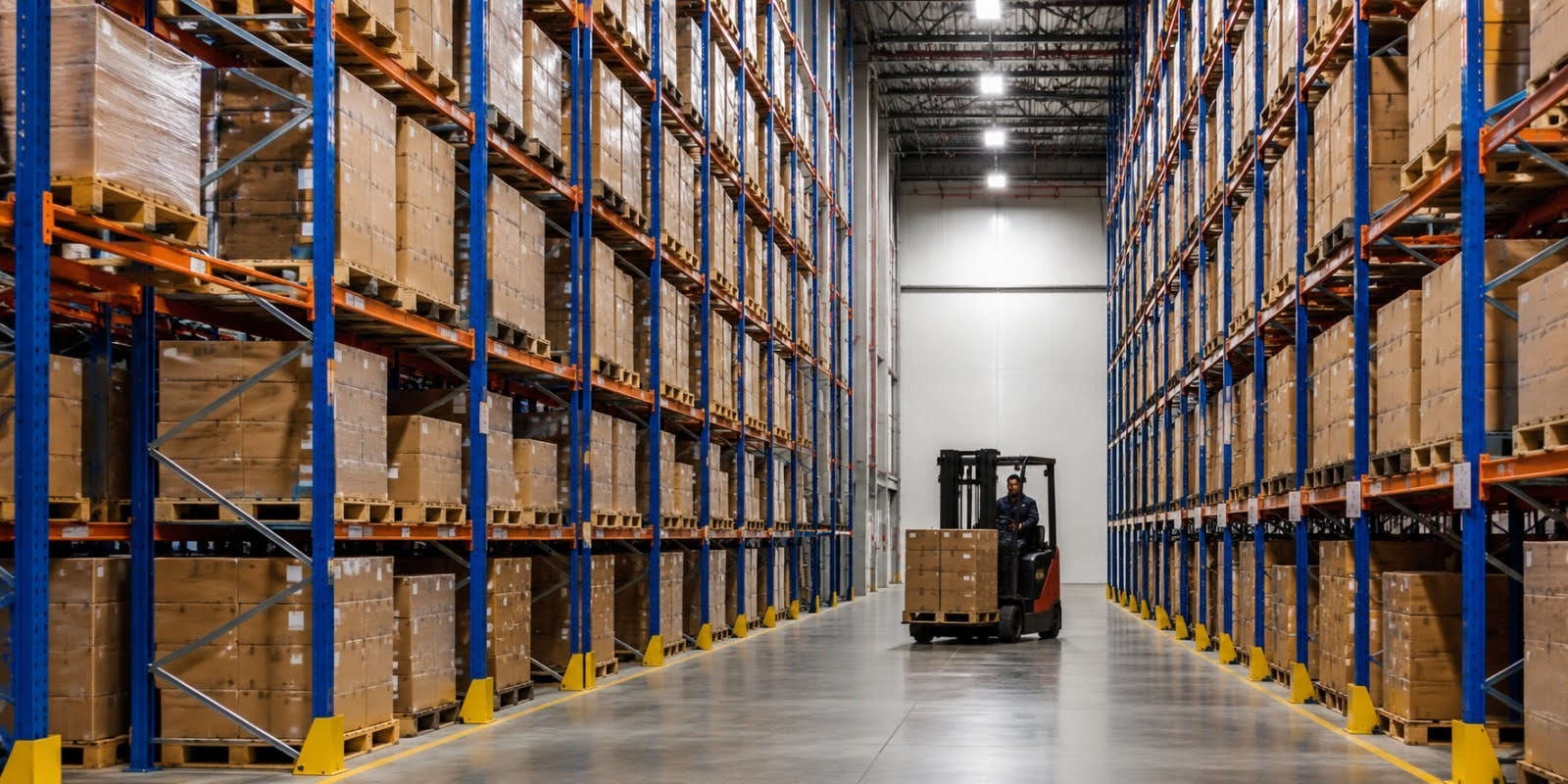
Warehouses use different types of racking systems. When it comes to a drive-in racking system in Singapore, this has been specifically designed to increase storage density by reducing the number of aisles required for pallet storage. Instead of providing an individual access aisle for every rack face, forklifts enter dedicated storage lanes to place and retrieve pallets.
This configuration can make better use of available warehouse floor and vertical space, particularly when businesses store large quantities of similar palletised goods. However, higher storage density comes with a trade-off: individual pallets are generally less directly accessible than they are in conventional selective pallet racking.
Drive-in racking is therefore most suitable when inventory characteristics, pallet consistency, stock rotation and handling requirements support lane-based storage.
Understanding how the system works is important before deciding whether its higher-density configuration is appropriate for a particular warehouse.
What Is a Drive-In Racking System?
Drive-in racking is a high-density pallet storage system that allows forklifts to enter the rack structure to place or retrieve pallets from storage lanes. Pallets are supported on rails running along each side of the lane rather than on conventional horizontal beams across the full rack face.
Multiple pallets can be stored one behind another and across several vertical levels.
Because forklifts operate within the storage lanes, fewer permanent aisles are required compared with selective pallet racking.
This allows a greater proportion of the available warehouse area to be dedicated to pallet positions.
The system is therefore primarily designed to improve storage density rather than provide immediate access to every individual pallet.
How Does Drive-In Racking Work?
Drive-in racking works by arranging pallet positions in deep storage lanes that forklifts enter from an access point. Pallets are normally placed at the deepest available position first and progressively stored towards the front of the lane.
The forklift enters the rack structure and raises the pallet to the appropriate storage level.
The pallet is then positioned on supporting rails within the lane.
Retrieval generally follows the reverse process. Pallets closer to the entrance need to be removed before pallets stored deeper within the same lane can be accessed.
This operating method means that inventory organisation is particularly important. Goods within the same lane should generally have compatible storage and stock-rotation requirements.
Why Drive-In Racking Provides Higher Storage Density
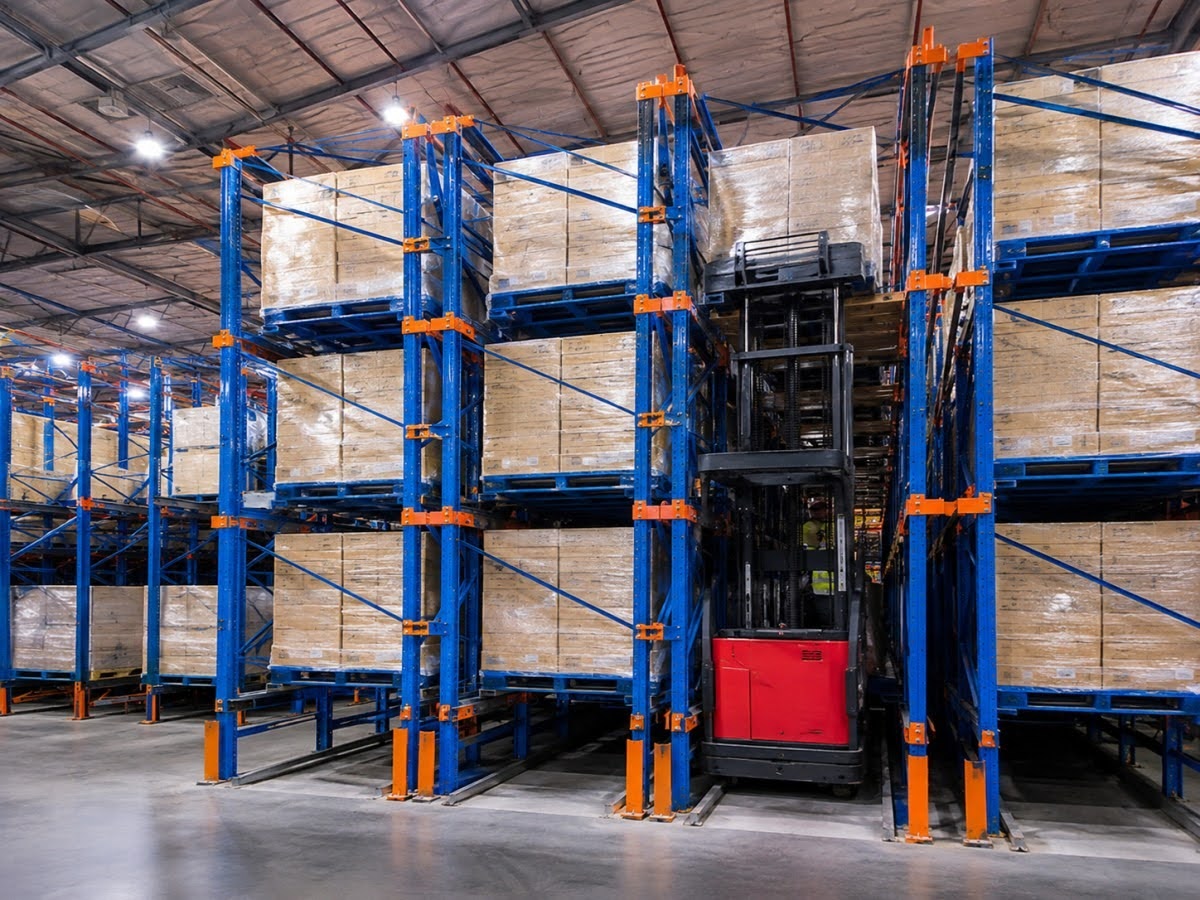
Drive-in racking increases storage density mainly by reducing the number of access aisles required within a warehouse. Conventional selective pallet racking normally requires an aisle between rack rows so forklifts can reach individual pallet positions.
Drive-in systems consolidate pallets into deeper lanes.
This allows more of the warehouse footprint to be occupied by storage positions rather than access routes.
The potential capacity improvement depends on several factors, including:
- Warehouse dimensions;
- Number and depth of storage lanes;
- Rack height;
- Pallet dimensions;
- Required forklift access; and
- Operational clearances.
Higher density should not be interpreted as simply placing racks as close together as possible. The system still requires sufficient operational space for safe and practical pallet handling.
Storage Density vs Selectivity
Storage density describes how much inventory can be accommodated within the available warehouse area, while selectivity describes how directly individual pallets can be accessed.
Drive-in racking prioritises density over selectivity.
Selective pallet racking generally provides direct access to a large proportion of individual pallets because each storage position faces an aisle. Drive-in racking reduces aisle space by storing pallets several positions deep.
The basic difference can be summarised as follows:
| Factor | Drive-In Racking | Selective Pallet Racking |
|---|---|---|
| Storage density | Higher | Lower |
| Individual pallet access | More limited | High |
| Number of aisles | Reduced | More aisles required |
| Lane depth | Multiple pallets | Usually one pallet deep |
| Suitable inventory | Larger quantities of similar stock | Higher SKU variety |
| Main objective | Maximise storage capacity | Maximise direct access |
The appropriate system therefore depends on whether capacity or immediate pallet access is more important to warehouse operations.
Which Inventory Is Suitable for Drive-In Racking?
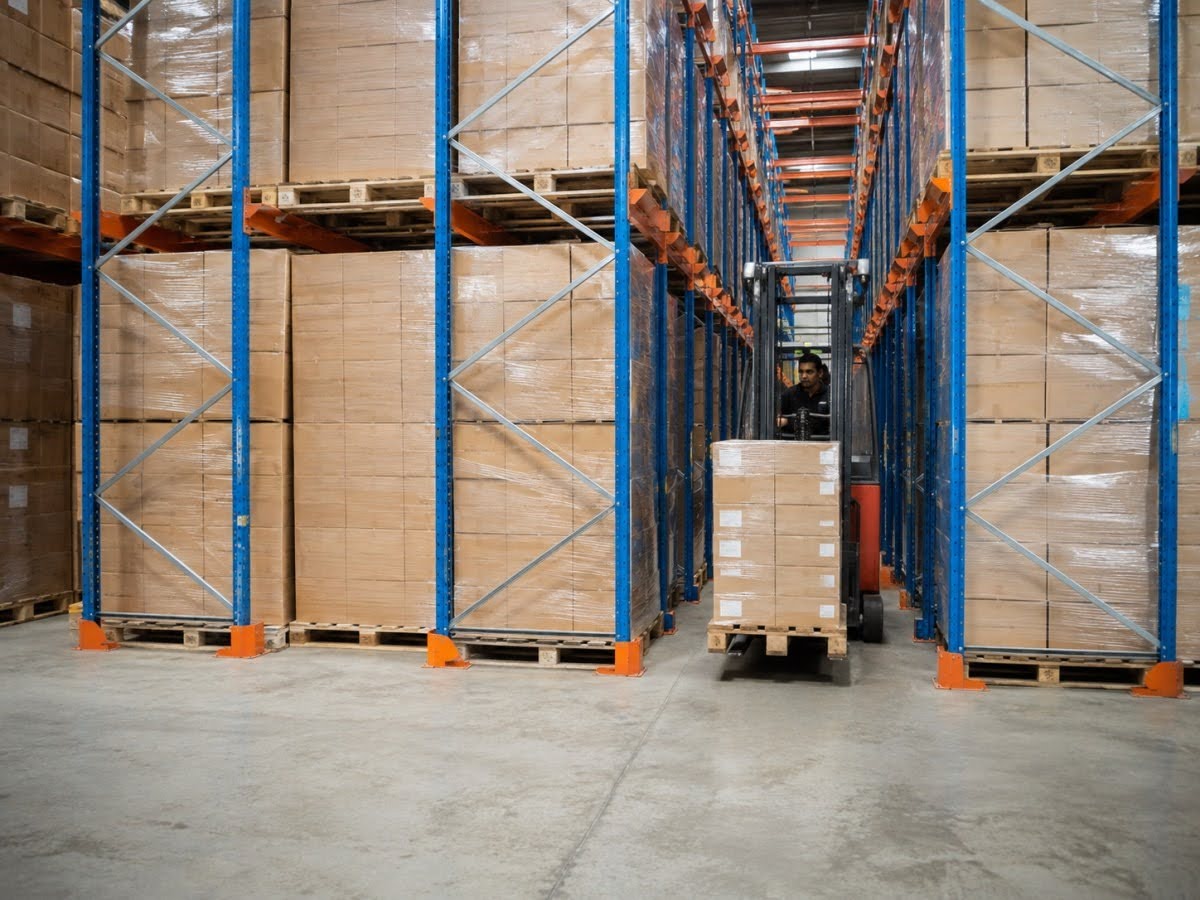
Drive-in racking is generally most suitable for palletised inventory stored in relatively large quantities per product type. This allows individual storage lanes to be assigned to compatible stock.
Warehouses with many pallets of the same SKU can make more effective use of deep lanes than facilities where almost every pallet contains a different product.
Suitable applications may include bulk goods, raw materials, finished products or reserve stock with predictable storage patterns.
Pallet dimensions should also be reasonably consistent with the racking configuration.
If pallet sizes and loads vary substantially, the storage system needs to be assessed carefully to determine whether a lane-based configuration remains practical.
SKU Quantity Matters in High-Density Storage
SKU quantity affects whether deep pallet lanes can be used efficiently. A SKU is an individual stock keeping unit used to distinguish one inventory item from another.
A warehouse storing many pallets per SKU can allocate complete lanes to individual products.
A warehouse containing hundreds of SKUs but only one or two pallets of each may not gain the same benefit. Deep lanes could create inaccessible stock or partially occupied positions.
This is why drive-in racking is often associated with lower SKU diversity and higher pallet quantities per SKU.
The inventory profile should be analysed before calculating the potential capacity benefit.
Understand Stock Rotation Requirements
Stock rotation determines the order in which inventory needs to enter and leave storage. Drive-in racking is commonly associated with a last-in, first-out approach because pallets are generally loaded and retrieved from the same side.
Under this arrangement, the most recently stored pallet is normally the easiest to retrieve.
This can be suitable where strict first-in, first-out rotation is not required.
Businesses should therefore assess product shelf life, batch management and inventory-control requirements before selecting the system.
Products with strict rotation requirements may require a different storage arrangement or another high-density system designed around the required inventory flow.
Forklift Access Is Central to the System
Forklift access is a defining feature of drive-in racking because the forklift physically enters the storage lane. The rack and operating environment must therefore be planned around the handling equipment.
Forklift dimensions influence lane clearances and overall rack configuration.
The operator also needs to align the vehicle and pallet accurately within the lane.
Because forklifts operate close to structural rack components, careful handling is particularly important.
The warehouse should consider equipment dimensions, lifting height, turning requirements and pallet handling procedures when designing the storage system.
A rack configuration should not be finalised independently of the equipment that will operate within it.
Pallet Configuration Affects Rack Design
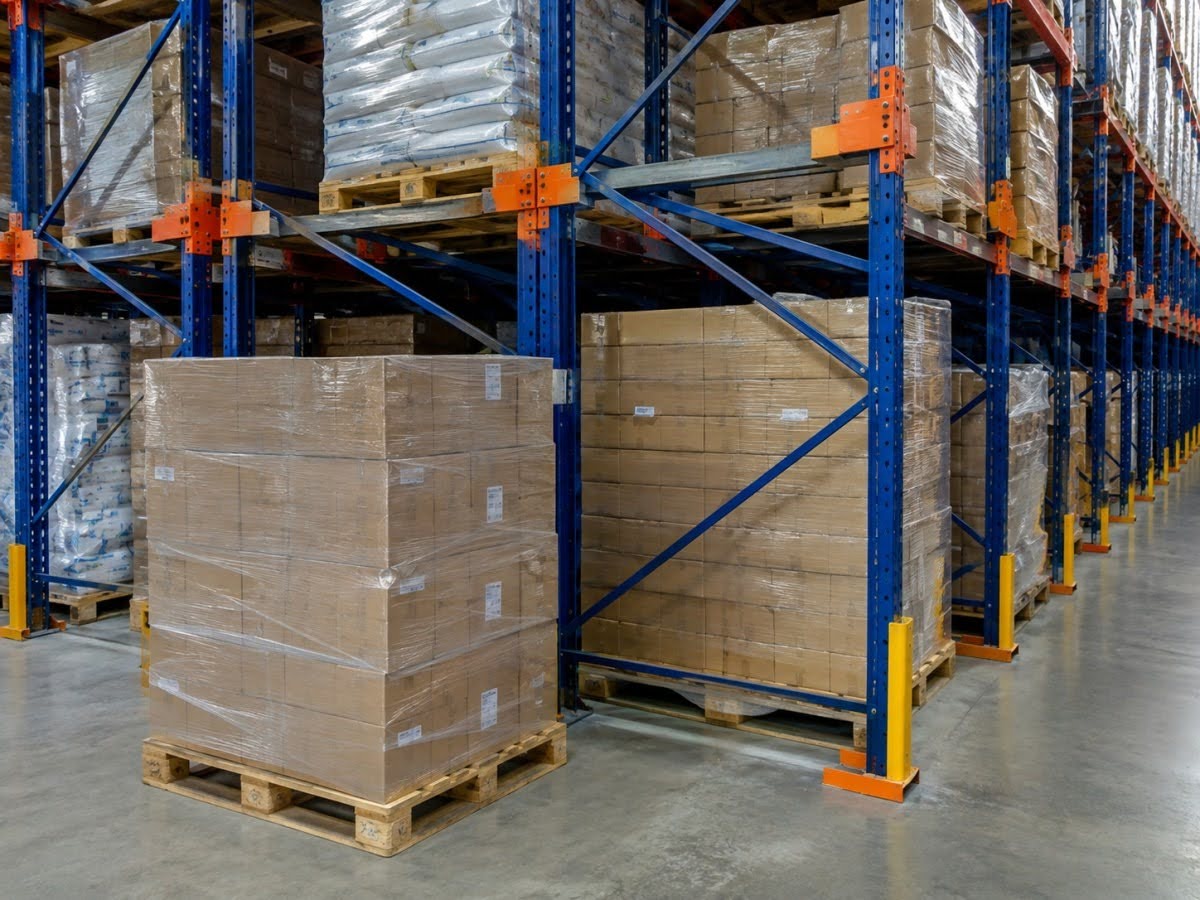
Pallet configuration includes pallet dimensions, construction, weight and load characteristics. These factors influence the design and operation of a drive-in storage lane.
Pallets need to interact correctly with the supporting rails.
The load should also remain stable during transport, placement and storage.
Where a warehouse handles several pallet types, compatibility should be reviewed rather than assuming every pallet can use the same lane.
The maximum expected pallet load is also important when determining system requirements.
Consistent pallet specifications generally make lane-based storage easier to organise and operate.
Using Vertical Warehouse Space
Drive-in racking can use both floor area and warehouse height by creating multiple pallet levels within deep storage lanes.
This allows warehouses to store inventory vertically rather than relying on extensive floor stacking.
However, usable rack height depends on the building and handling equipment.
Ceiling clearances, structural conditions, services and forklift lifting capabilities can all influence the practical number of storage levels.
Vertical capacity should therefore be calculated around usable operating conditions rather than the maximum physical building height alone.
Advantages of Drive-In Racking
The main advantage of drive-in racking is its ability to increase pallet storage density for compatible inventory profiles.
By reducing access aisles and creating deep lanes, the system can allocate a larger portion of warehouse space to storage.
Other potential advantages include:
- Efficient storage of large pallet quantities per SKU;
- Improved use of vertical warehouse space;
- Reduced aisle requirements;
- Organised lane-based bulk storage; and
- Suitability for reserve or high-volume pallet stock.
These benefits depend on the inventory being appropriate for the system.
A high-density rack provides limited value if operational requirements demand frequent access to individual pallets throughout the lanes.
Limitations of Drive-In Racking
The main limitation of drive-in racking is reduced selectivity. Pallets stored deeper within a lane cannot normally be accessed directly without removing pallets positioned in front of them.
This makes product allocation and stock rotation important.
Forklift movement inside the rack structure also requires careful operation because vehicles work close to rack components.
Another consideration is SKU diversity. Warehouses storing small quantities of many different products may struggle to use deep lanes efficiently.
These limitations do not make the system unsuitable in general. They define the inventory and operational conditions under which drive-in racking works most effectively.
Drive-In Racking and Warehouse Workflow
Warehouse workflow should be considered before deciding where drive-in racking will be positioned. High-density storage can reduce the warehouse footprint required for pallets, but goods still need efficient routes between receiving, storage and dispatch.
Bulk reserve stock may be placed in high-density storage while frequently picked goods are positioned in more directly accessible areas.
This allows a warehouse to combine different storage approaches according to inventory movement.
Drive-in racking does not necessarily need to be the only storage system within a facility.
For mixed operations, using it selectively for suitable inventory can provide a better balance between capacity and accessibility.
When Should a Warehouse Consider Drive-In Racking?
A warehouse should consider drive-in racking when increasing pallet capacity is important and the inventory profile supports deep-lane storage.
The system may be appropriate when:
- High SKU Volume: Large quantities of similar palletised goods are stored;
- Reduced Need for Direct Access: Direct access to every pallet is not essential;
- Compatible Stock Rotation: The stock rotation method suits lane-based storage;
- Uniform Pallet Sizes: Pallet sizes and loads are compatible;
- Equipment Compatibility: Suitable forklifts are available; and
- Space Optimization: Reducing aisle space would create meaningful capacity benefits.
If these conditions are not present, another pallet storage system may provide better operational efficiency despite having lower theoretical density.
Planning Drive-In Racking for a Singapore Warehouse
Planning a drive-in racking system in a Singapore facility requires an assessment of both physical space and inventory characteristics. Warehouse dimensions alone cannot determine whether the system is appropriate.
Businesses should review pallet quantities per SKU, load characteristics, stock rotation and forklift requirements.
The available floor and vertical space can then be assessed against the proposed lane depth and rack height.
Operational areas should also remain available for receiving, staging and dispatch.
The objective should be to increase useful storage capacity without creating unnecessary handling difficulties elsewhere in the warehouse.
Frequently Asked Questions (FAQs)
What is drive-in racking?
Drive-in racking is a high-density pallet storage system where forklifts enter storage lanes to place and retrieve pallets. It reduces the number of aisles required by storing multiple pallets one behind another.
Why does drive-in racking save warehouse space?
It reduces the floor area allocated to access aisles compared with conventional selective pallet racking. More of the available warehouse footprint can therefore be used for pallet positions.
What products are suitable for drive-in racking?
The system is generally suitable for large quantities of similar palletised products. It can be particularly practical when several pallets of the same SKU can occupy one storage lane.
Does drive-in racking provide direct access to every pallet?
No. Pallets stored deeper within a lane are normally accessed after pallets closer to the entrance have been removed. This is one of the main trade-offs of higher-density storage.
Is drive-in racking suitable for warehouses with many SKUs?
It can be less efficient where a warehouse has many SKUs but only a small number of pallets for each one. The system generally performs better when sufficient pallet quantities are available to make effective use of deep storage lanes.
Can drive-in racking be combined with other racking systems?
Yes. Warehouses can use drive-in racking for bulk or reserve stock while using selective pallet racking or shelving for inventory requiring more frequent direct access.
Making High-Density Storage Work for the Right Inventory
Drive-in racking can significantly change how warehouse space is allocated by replacing multiple access aisles with deep pallet storage lanes. Its main purpose is to increase storage density for inventory that does not require immediate access to every pallet.
The system is particularly relevant where businesses store substantial quantities of similar palletised goods and can organise inventory around lane-based storage.
However, storage density should not be evaluated independently of selectivity, forklift access, stock rotation and SKU quantity. A drive-in racking system in Singapore warehouses should fit both the physical facility and the way inventory actually moves through it.
Assess Whether Drive-In Racking Fits Your Warehouse
High-density pallet storage should be planned around inventory quantities, pallet configuration, stock rotation, forklift access and available warehouse space. Eastern Win Enterprises Pte Ltd. provides racking systems for different industrial and warehouse storage requirements in Singapore.
To discuss whether drive-in racking is appropriate for your storage requirements, you can contact Eastern Win Enterprises Pte Ltd.